
AI research technologies that cover data pipelines, training workflows, and deployment describe the systematic processes used to turn raw data into trained models and then operate those models in experiments or production-like settings. The concept includes ingesting and validating data, transforming and versioning datasets, defining and executing training procedures, tracking experiments, evaluating model behavior, and packaging models for deployment. Each stage interacts with infrastructure and tooling choices that can affect reproducibility, resource use, and the ability to compare alternatives. Describing the concept requires attention to both the technical steps and the practices that support rigorous research workflows.
Within this framework, data pipelines refer to the automated sequences that collect, clean, and prepare data for modeling; training workflows denote the orchestration of model optimization, hyperparameter exploration, and checkpointing; deployment covers packaging, serving, and monitoring of models. Research-oriented implementations often emphasize traceability and experiment metadata so that outputs can be reproduced or audited. Tooling choices may vary by project scale and objectives, and typical workflows can interoperate with experiment tracking systems, continuous integration for models, and container-based runtime environments.
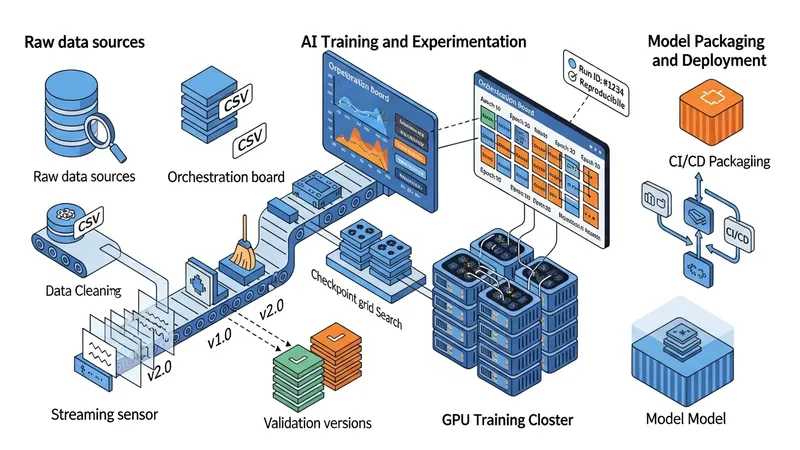
These examples were selected as representative tools often referenced in research settings: one focused on pipeline orchestration, one on model training, and one on deployment orchestration. Descriptions are neutral and intended to show how different components can align in a research lifecycle. In practice, a team may combine an orchestration tool like Apache Airflow to produce datasets that feed into training runs implemented with frameworks such as PyTorch; trained artifacts may then be containerized and scheduled using systems like Kubernetes. The rest of this page expands on interactions among these example components.
Data orchestration tools such as Airflow may handle periodic ingestion, data quality checks, and triggering of downstream training workflows. When pipelines include schema validation and lineage capture, researchers can more readily trace model inputs back to raw sources and transformations. Using pipeline operators to emit metadata or artifacts into an experiment tracking system can simplify comparisons between model versions. Considerations often include how to store intermediate datasets, how to version transformation logic, and how to balance automation with manual inspection during exploratory stages.
Training frameworks like PyTorch frequently provide mechanisms for checkpointing, mixed-precision training, and distributed execution that can be integrated into research workflows. Researchers often use experiment tracking tools to record hyperparameters, random seeds, and metrics so that runs are comparable. Distributed training setups may reduce iteration time but add complexity in debugging and reproducibility; for example, synchronization of random states and consistent data sharding are typical concerns. Integrations between training code and pipeline orchestration can help automate full retraining when upstream data changes.
Deployment orchestration platforms such as Kubernetes may be used to standardize runtime environments for model serving, enabling researchers to test models under production-like constraints. Container images can encapsulate runtime dependencies and model artifacts, and service meshes or ingress controllers may manage traffic for evaluation scenarios. Monitoring and logging during deployment can capture performance and behavior drift over time; in research contexts, such telemetry may be used to inform further experiments rather than drive live corrective actions. Packaging decisions often consider reproducibility, resource limits, and experiment isolation.
Combining these components often involves trade-offs: greater automation can improve throughput but may require more engineering effort to ensure reproducibility; lightweight, ad hoc scripts may be quicker for exploration but harder to scale or audit. Researchers commonly design modular workflows where pipelines, training loops, and deployment artifacts are versioned and linked through metadata. This modularity can facilitate iterative cycles and allow teams to replace or upgrade individual components without reworking entire workflows. The next sections examine practical components and considerations in more detail.
Data ingestion and pipeline design form the foundation for experimental rigor. In research contexts, pipelines may include steps for raw data capture, de-duplication, schema enforcement, anonymization, and sampling strategies. Typical pipelines may emit standardized dataset artifacts along with metadata such as provenance, processing timestamps, and checksums. Researchers often consider storage formats (for example, columnar formats for analytical workloads) and access patterns when designing pipelines. Practical considerations may include trade-offs between storing multiple processed versions for speed versus computing transforms on the fly to save storage.
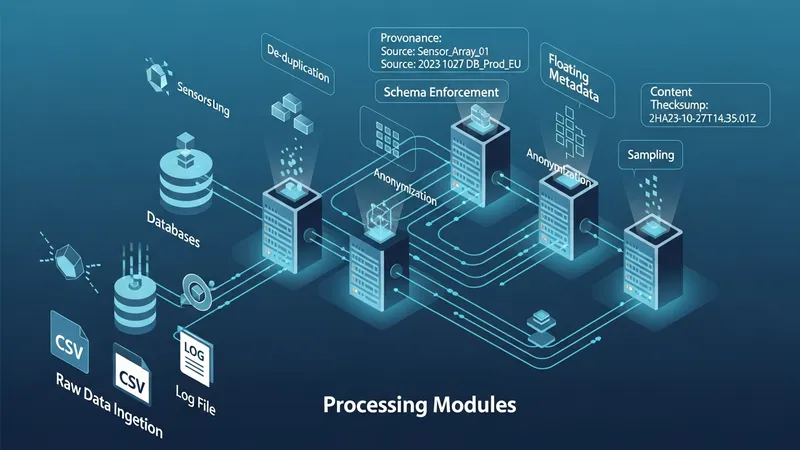
Versioning datasets can often improve reproducibility by enabling exact reconstitution of inputs used for a specific training run. Tools and conventions may support dataset snapshots, content-addressed storage, or manifest files that list constituent files and their checksums. Researchers may also track dataset lineage so that model results can be traced back to upstream sources and transformations. When pipelines include synthetic data generation or augmentation, documenting configuration and random seeds often helps other researchers interpret experimental outcomes.
Pipeline orchestration choices may affect how easily data flows into training workflows. Apache Airflow and similar systems often provide scheduling, retries, and dependency management, which can be useful when pipelines must coordinate across systems (databases, object stores, message queues). Researchers may use lightweight task runners during prototyping and switch to more robust orchestration for larger experiments. Tips as considerations include adopting clear naming conventions for pipeline tasks, centralizing configuration, and emitting structured logs to ease debugging when failures occur.
Data validation and quality checks are commonly integrated into pipelines to detect distributional shifts, missing values, or schema violations before training. Automated checks can prevent wasted compute on training runs that use corrupted inputs. Researchers typically balance the depth of validation with iteration speed: simple checks may catch obvious issues early, while more complex validations can run periodically or as part of gating before major experiments. These choices often reflect resource constraints and the desired level of assurance in experimental results.
Training workflows encapsulate the sequence of steps that move from dataset artifacts to trained model checkpoints and evaluation metrics. Core elements typically include data loading and augmentation, model initialization, optimization loops, checkpointing, and metric logging. Research-oriented workflows may incorporate hyperparameter sweeps, ablation studies, and controlled variations to probe behavior. Integration with experiment tracking systems allows recording of configurations, seed values, and metric trajectories so that researchers can compare runs and reproduce selected experiments with the same settings.

Experiment tracking tools often capture metadata about the training environment such as library versions, hardware configuration, and elapsed wall time. This contextual information can be important when results are sensitive to software or hardware differences. Researchers may store artifacts like model weights, evaluation outputs, and sample predictions together with run metadata. Typical considerations include the storage cost of frequent checkpoints, how to retain only the most informative artifacts, and how to index runs for later analysis.
Distributed training techniques may speed up iteration but introduce challenges in determinism and debugging. Common approaches include data-parallel and model-parallel strategies; their applicability often depends on model size and hardware availability. When using distributed execution, researchers often pay attention to reproducible initialization, consistent batching, and the handling of non-deterministic operations. Practical tips presented as considerations include validating single-node behavior thoroughly before scaling and documenting communication strategies used for synchronization.
Linking training workflows to upstream data pipelines and downstream deployment artifacts is useful for lifecycle management. For instance, pipeline triggers can initiate retraining when new data meets certain criteria, and tracked experiment artifacts can be used to build container images for testing in staging environments. Researchers often outline interfaces between components so that changes in one area (e.g., a new preprocessing step) are reflected in recorded experiment metadata. These interfaces can simplify replication of experiments and reduce hidden dependencies.
Evaluation methods determine how model performance is assessed and interpreted in research workflows. Common evaluation elements include held-out test sets, cross-validation, task-specific metrics, and error analysis procedures. Researchers often define evaluation protocols that separate development (validation) data from final test data to avoid overfitting to evaluation criteria. Considerations include selecting representative evaluation datasets, reporting confidence intervals where appropriate, and documenting pre-processing applied to evaluation inputs to ensure fair comparisons across runs.

Dataset preparation practices such as stratified sampling, annotation standards, and class balancing can affect the types of conclusions that can be drawn from experiments. Researchers typically document labeling procedures, inter-annotator agreement statistics, and any filtering applied to raw collections. In cases where labels are noisy or costly, techniques such as label smoothing, uncertainty-aware loss functions, or curated validation subsets may be used to better interpret model behavior. These are presented as considerations rather than prescriptive steps, since appropriateness depends on research goals.
Quantitative evaluation often pairs with qualitative analyses to surface failure modes and edge cases. For example, error analysis on confusion matrices, per-slice metrics, and sample-level inspection can inform subsequent experiments. Researchers may use targeted test sets to probe specific behaviors such as sensitivity to input perturbations or robustness to distribution shifts. A typical practice is to record both aggregated metrics and per-case observations so that claims about model performance remain supported by analyzable evidence.
Reproducible evaluation benefits from versioned datasets, fixed random seeds, and documented preprocessing pipelines. When publishing results or sharing artifacts internally, researchers often include dataset manifests and evaluation scripts so others can rerun assessments under comparable conditions. Considerations may include the storage and compute costs of rerunning extensive evaluations and the level of automation required to keep evaluations synchronized with evolving code and data.
Deployment processes describe how trained models are packaged, served, and monitored in environments used for further testing or production evaluation. Packaging approaches frequently involve containerization to freeze runtime dependencies and model artifacts. Serving layers can be lightweight inference scripts for interactive experiments or production-grade APIs managed by orchestration platforms for scale. Researchers may use staged rollouts or canary tests when evaluating models under realistic traffic patterns. Discussions of deployment emphasize traceability and isolation to ensure that experiments do not inadvertently impact other systems.
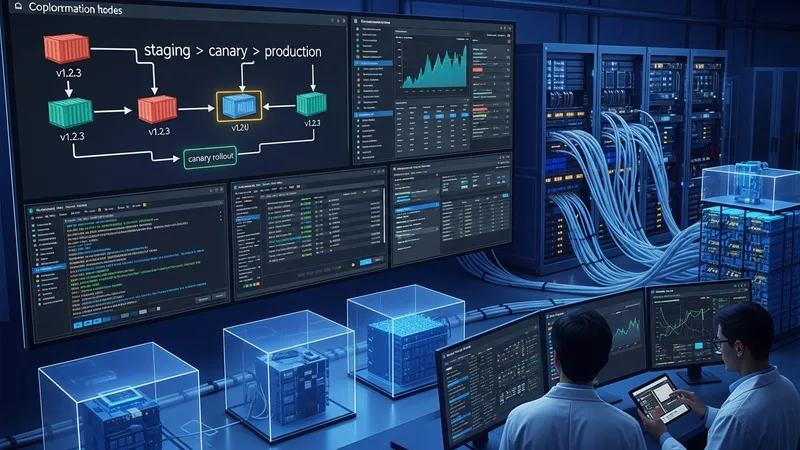
Infrastructure requirements often depend on model complexity and expected throughput. GPUs or specialized accelerators may be used for inference in some research evaluations, while CPU-based serving may suffice for small-scale testing. Storage and network considerations are also relevant when models require large datasets or when serving must support streaming inputs. Researchers commonly document resource footprints of candidate models to inform infrastructure decisions and to estimate reproducibility costs for others attempting similar experiments.
Monitoring and observability are important for understanding deployed model behavior and for informing new research iterations. Metrics such as latency, throughput, input distributions, and key performance indicators from evaluation suites may be logged and analyzed. Telemetry can reveal performance degradation or unexpected behaviors that warrant retraining or reevaluation. As a consideration, researchers often balance the granularity of telemetry with storage and analysis costs, choosing to log detailed traces selectively for targeted investigations.
Experiment lifecycle management spans from initial data collection through training, evaluation, and eventual deployment or archival. Maintaining clear links between dataset versions, experiment records, model artifacts, and deployment manifests helps preserve reproducibility and institutional memory. Researchers may adopt conventions for artifact naming, metadata schemas, and retention policies to support long-term research programs. These practices are presented as considerations that can be adapted to project scale and available resources, aiding methodical progression through research cycles.